
What Is a Refinery Feasibility Study? A Complete Guide for Project Owners

Introduction
A refinery feasibility study is one of the most important steps before investing in a refinery or petrochemical project. These projects require substantial capital, technical expertise, regulatory approvals, and long-term planning. A well-executed feasibility study helps project owners evaluate risks, estimate costs, assess technical requirements, and make informed investment decisions before committing resources.
This is where a refinery feasibility study plays a critical role.
A feasibility study is much more than a preliminary review. It is a structured evaluation that helps project owners understand potential opportunities, identify risks, estimate costs, and make informed investment decisions before moving into detailed engineering and execution.
Consider a refinery expansion project intended to increase production capacity. On paper, the project may appear profitable. However, if feedstock availability, utility requirements, product demand, environmental regulations, or operating costs are not thoroughly evaluated, unexpected challenges can emerge later in the project lifecycle. These challenges often result in schedule delays, budget overruns, and reduced project returns.
A comprehensive refinery feasibility study helps uncover these issues early, when changes are still manageable and significantly less expensive to implement.
In this guide, we will explore what a refinery feasibility study is, why it is important, the key components involved, and how it helps project owners make better business and engineering decisions.
What Is a Refinery Feasibility Study?
A refinery feasibility study is a systematic assessment conducted before the development, expansion, revamp, or modernization of a refinery, petrochemical, or chemical processing facility.
The objective is to determine whether a project is technically feasible, economically viable, environmentally compliant, and aligned with business goals.
Rather than relying on assumptions, a feasibility study uses engineering analysis, market assessments, financial evaluations, and risk assessments to provide a realistic picture of the project’s potential performance.
For project owners, investors, and decision-makers, the study serves as a foundation for investment decisions and future project planning.
A refinery feasibility study typically evaluates:
- Market demand and product opportunities
- Technical configuration and process selection
- Capital and operating cost estimates
- Utility and infrastructure requirements
- Environmental and regulatory considerations
- Project risks and mitigation strategies
- Economic performance and profitability
The final outcome is a detailed assessment that helps stakeholders determine whether the project should proceed, be modified, or be reconsidered.
Organizations planning refinery, petrochemical, or chemical industry projects often begin with a comprehensive feasibility study to evaluate technical, financial, and operational viability.
Why Feasibility Studies Matter in Refinery and Petrochemical Projects
Refinery and petrochemical projects are among the most capital-intensive industrial investments. Whether the objective is to build a new facility, expand production capacity, improve product yields, or modernize existing operations, every decision made during the early planning stages can have a significant impact on project success.
A feasibility study helps project owners evaluate these decisions before substantial investments are committed.
Without a structured feasibility assessment, project teams often rely on assumptions regarding market demand, process selection, feedstock availability, utility requirements, and project economics. While some assumptions may prove accurate, others can create unexpected challenges during detailed engineering, procurement, construction, or plant operation.
For example, consider a refinery expansion project designed to increase diesel production. Initial market projections may indicate strong demand and attractive profit margins. However, a detailed feasibility study may reveal additional utility requirements, limitations within existing process units, or environmental compliance challenges that could significantly affect project economics.
Identifying such issues early provides an opportunity to evaluate alternatives before major costs are incurred.
A well-executed refinery feasibility study helps organizations:
- Assess technical viability before detailed engineering begins.
- Evaluate project economics and expected returns.
- Estimate capital expenditure (CAPEX) and operating expenditure (OPEX).
- Identify technical, commercial, and operational risks.
- Review environmental and regulatory requirements.
- Support informed investment and financing decisions.
- Improve project planning and resource allocation.
In today’s competitive refining and petrochemical environment, project owners cannot afford to make decisions based solely on assumptions. Feasibility studies provide the data-driven insights needed to reduce uncertainty and improve the likelihood of project success.
| Project Aspect | With a Feasibility Study | Without a Feasibility Study |
|---|---|---|
| Project Planning | Detailed analysis and planning | Based on assumptions |
| CAPEX Estimation | More accurate budgeting | Higher risk of overruns |
| Technical Risks | Identified early | Discovered later |
| Regulatory Compliance | Evaluated in advance | Possible approval delays |
| Project Schedule | Better timeline planning | Greater risk of delays |
| Investment Decisions | Data-driven decisions | Higher uncertainty |
The Five Major Components of a Refinery Feasibility Study
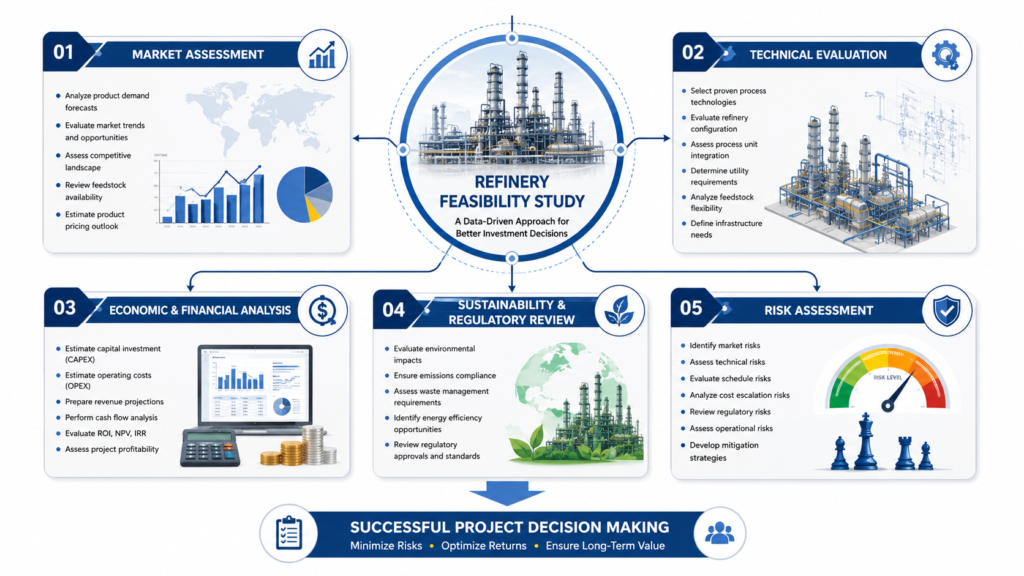
A refinery feasibility study combines technical, commercial, financial, and regulatory assessments to determine whether a project should move forward. Although the scope may vary depending on project size and complexity, most studies include five key components.
1. Market Assessment
Before investing in a refinery or petrochemical project, it is important to understand market conditions and future demand.
A market assessment evaluates factors such as:
- Product demand forecasts
- Market trends
- Competitive landscape
- Feedstock availability
- Product pricing outlook
For example, a project focused on increasing gasoline production may require a different business case than a project targeting petrochemical feedstocks or specialty chemicals.
Understanding market opportunities helps ensure that the project aligns with long-term business objectives.
2. Technical Evaluation
Technical feasibility focuses on determining whether the proposed project can be successfully implemented from an engineering and operational perspective.
This assessment typically includes:
- Process technology selection
- Refinery configuration evaluation
- Process unit integration
- Utility requirements
- Feedstock flexibility analysis
- Infrastructure requirements
The goal is to identify the most practical and efficient technical solution while minimizing operational risks.
Technical evaluations often involve process modelling and simulation to assess plant performance, process integration, and operational efficiency under different scenarios.
Advanced engineering studies may also include detailed process equipment design to ensure reliable and efficient plant operation.
3. Economic and Financial Analysis
A technically feasible project may not always be economically viable.
Economic analysis examines:
- Capital investment requirements
- Operating costs
- Revenue projections
- Cash flow analysis
- Return on investment (ROI)
- Net Present Value (NPV)
- Internal Rate of Return (IRR)
These evaluations help project owners determine whether the expected benefits justify the required investment.
4. Sustainability and Regulatory Review
Modern refinery and petrochemical projects must comply with environmental regulations, safety standards, and sustainability requirements.
This part of the feasibility study may include:
- Environmental impact considerations
- Emissions compliance
- Waste management requirements
- Energy efficiency opportunities
- Regulatory approvals
Addressing these requirements early can help prevent delays during project execution.
Many projects identify opportunities for energy optimization and utility integration during the feasibility stage to improve long-term operational efficiency.
5. Risk Assessment
Every industrial project involves uncertainty.
A risk assessment identifies potential challenges that could affect project performance, including:
- Market risks
- Technical risks
- Schedule risks
- Cost escalation risks
- Regulatory risks
- Operational risks
Once identified, mitigation strategies can be developed to reduce the likelihood and impact of these risks.
What Happens When a Refinery Feasibility Study Is Skipped?
Many project owners understand the importance of planning, but under schedule pressure or market demand, some projects move forward without a comprehensive feasibility assessment.
At first, this may appear to save time. In reality, it often creates challenges later in the project lifecycle.
Consider a refinery planning to increase production capacity to meet growing demand. Initial projections suggest strong market opportunities, and management is eager to move quickly. Based on preliminary assumptions, the project appears technically straightforward and financially attractive.
However, during detailed engineering, several issues begin to emerge.
The existing utility system cannot support the additional steam and cooling water requirements. Feedstock characteristics differ from the assumptions used during early planning. Environmental compliance requirements are more extensive than anticipated. In addition, some existing process units require modifications to accommodate the planned capacity increase.
As a result, project costs begin to rise. Engineering revisions become necessary. Procurement schedules are affected, and project completion dates are pushed back.
While this example is simplified, situations like these are common across industrial projects when critical factors are not thoroughly evaluated during the planning stage.
A comprehensive refinery feasibility study helps identify such challenges before major investments are committed. By evaluating technical requirements, project economics, utility integration, regulatory considerations, and operational constraints early in the process, organizations can make informed decisions and reduce the likelihood of costly surprises later.
The objective of a feasibility study is not simply to approve a project. Sometimes its greatest value comes from identifying potential risks and highlighting opportunities for improvement before the project moves forward.
Common Challenges Identified During a Refinery Feasibility Study
One of the primary goals of a refinery feasibility study is to uncover issues that could affect project success. Identifying these challenges early allows project teams to evaluate alternatives and implement corrective actions before significant resources are invested.
Some of the most common challenges identified during feasibility studies include:
Feedstock Availability and Flexibility
The availability and quality of feedstocks can have a major impact on project economics and operational performance.
A feasibility study evaluates whether the proposed facility can efficiently process available feedstocks while maintaining desired product yields and operational reliability.
Utility and Infrastructure Constraints
Projects often require additional utilities such as steam, power, cooling water, compressed air, or hydrogen.
If existing infrastructure cannot support future requirements, significant upgrades may be necessary. Identifying these limitations early helps avoid unexpected capital expenditures later.
Market and Product Demand Uncertainty
Even technically successful projects can struggle if market demand does not meet expectations.
Feasibility studies evaluate product demand forecasts, pricing trends, competitive pressures, and market opportunities to support informed investment decisions.
Environmental and Regulatory Requirements
Environmental regulations continue to evolve across the refining and petrochemical sectors.
A feasibility study helps identify permitting requirements, emissions considerations, environmental impacts, and compliance obligations that may influence project scope and schedule.
Capital Cost Escalation
Project costs can increase significantly due to changes in design, equipment requirements, construction challenges, or market conditions.
Early cost estimation and risk assessment help project owners understand potential financial exposure and develop realistic budgets.
Operational and Technical Risks
Every industrial project carries technical risks related to process technology, equipment performance, integration challenges, and operational reliability.
Feasibility studies help evaluate these risks and develop mitigation strategies before project execution begins.
The 7 Key Steps in Conducting a Refinery Feasibility Study
Although every project is unique, most refinery and petrochemical feasibility studies follow a structured approach.
1. Define Project Objectives
The first step is to clearly establish project goals, expected outcomes, production targets, and business objectives.
2. Collect Technical and Commercial Data
Relevant process, market, feedstock, utility, infrastructure, and financial information is gathered to support the assessment.
3. Evaluate Technical Feasibility
Engineers assess process technologies, facility configurations, utility requirements, equipment needs, and operational considerations.
4. Conduct Market Assessment
Potential market demand, product pricing, competitive conditions, and long-term opportunities are analyzed.
5. Perform Economic and Financial Analysis
Capital costs, operating costs, cash flow projections, return on investment, and project profitability are evaluated.
6. Assess Risks and Regulatory Requirements
Technical, commercial, environmental, and operational risks are identified and reviewed alongside regulatory obligations.
7. Develop Recommendations and Final Report
The findings are consolidated into a feasibility study report that provides project owners with clear recommendations and decision-making support.
How Feasibility Studies Help Reduce Project Risks
Every refinery, petrochemical, or chemical project involves a certain level of risk. These risks may be technical, financial, operational, environmental, or market-related. While risks cannot be completely eliminated, a comprehensive refinery feasibility study helps identify potential challenges early and develop strategies to manage them effectively.
One of the biggest advantages of conducting a feasibility study is that it enables project owners to make decisions based on data rather than assumptions. Instead of discovering problems during construction or plant operation, organizations can identify potential obstacles during the planning stage when corrective actions are less expensive and easier to implement.
A feasibility study helps reduce project risks by:
- Identifying technical limitations before detailed engineering begins.
- Evaluating project economics under different market conditions.
- Assessing utility and infrastructure requirements.
- Reviewing environmental and regulatory obligations.
- Identifying potential schedule and cost escalation risks.
- Supporting realistic project planning and budgeting.
For example, a refinery expansion project may initially appear profitable based on expected product demand. However, a feasibility study could reveal utility bottlenecks, additional environmental compliance requirements, or higher-than-expected operating costs. Identifying these issues early allows project teams to evaluate alternative solutions and improve project outcomes.
Ultimately, a feasibility study provides a clearer understanding of project risks and helps organizations move forward with greater confidence.
What Project Owners Should Look for in a Feasibility Study Consultant
The quality of a feasibility study depends largely on the experience and expertise of the consulting team performing the assessment.
A reliable feasibility study consultant should possess a strong understanding of refinery operations, petrochemical processes, project economics, regulatory requirements, and engineering best practices.
When selecting a feasibility study consultant, project owners should consider the following factors:
Industry Experience
Look for consultants with experience in refinery, petrochemical, chemical processing, and industrial infrastructure projects.
Technical Expertise
The consulting team should have expertise in process engineering, utility systems, process integration, project evaluation, and technology assessment.
Economic Evaluation Capabilities
A strong feasibility study should include realistic CAPEX estimates, OPEX analysis, profitability assessments, cash flow projections, and investment evaluations.
Regulatory Understanding
The consultant should understand environmental regulations, permitting requirements, safety standards, and sustainability considerations relevant to the project.
Risk Assessment Approach
An effective consultant identifies potential risks and provides practical mitigation strategies rather than simply highlighting problems.
Integrated Project Perspective
The best feasibility studies combine technical, commercial, financial, and regulatory evaluations into a single decision-making framework.
Selecting the right consulting partner can significantly improve the quality of project planning and increase the likelihood of long-term project success.
Frequently Asked Questions (FAQs)
What is a refinery feasibility study?
A refinery feasibility study is a structured assessment that evaluates the technical, financial, operational, environmental, and commercial viability of a refinery project before major investments are made.
Why is a feasibility study important before starting a refinery project?
A feasibility study helps project owners understand project opportunities, identify risks, estimate costs, evaluate profitability, and make informed investment decisions.
What are the major components of a refinery feasibility study?
A typical refinery feasibility study includes market assessment, technical evaluation, economic and financial analysis, sustainability and regulatory review, and risk assessment.
What types of feasibility assessments are included in refinery projects?
Refinery projects typically involve technical feasibility, economic feasibility, operational feasibility, commercial feasibility, environmental feasibility, and regulatory feasibility assessments.
What are the key steps in conducting a refinery feasibility study?
The process generally includes defining project objectives, collecting project data, conducting technical evaluations, performing market assessments, analyzing project economics, evaluating risks, and developing recommendations.
How does a feasibility study help reduce project risks?
A feasibility study identifies potential technical, financial, operational, and regulatory challenges early, allowing project teams to implement mitigation strategies before project execution begins.
What is the difference between technical feasibility and economic feasibility?
Technical feasibility evaluates whether a project can be successfully implemented from an engineering perspective, while economic feasibility determines whether the project is financially attractive and commercially viable.
How long does a refinery feasibility study typically take?
The duration depends on project complexity, scope, and data availability. Small studies may take a few weeks, while large refinery and petrochemical projects can require several months.
Who should conduct a refinery feasibility study?
Experienced engineering consulting firms with expertise in refinery, petrochemical, and chemical industry projects are typically responsible for conducting feasibility studies.
What can happen if a refinery project skips the feasibility study phase?
Projects that skip feasibility studies may face cost overruns, schedule delays, technical challenges, regulatory issues, and lower-than-expected financial performance.
Conclusion
A refinery feasibility study is one of the most important steps in the development of any refinery, petrochemical, or chemical industry project. By evaluating technical feasibility, market opportunities, project economics, environmental requirements, and potential risks, feasibility studies provide the insights needed to support informed investment decisions.
In today’s competitive industrial landscape, successful projects are built on thorough planning and sound engineering analysis. Organizations that invest in comprehensive feasibility studies are better positioned to reduce uncertainty, optimize resources, manage risks, and improve long-term project performance.
Whether you are planning a new refinery facility, expanding existing operations, or evaluating a petrochemical investment opportunity, a well-executed feasibility study provides the foundation for project success.
Successful industrial projects are built on informed decisions, thorough planning, and sound engineering analysis.
Need Expert Feasibility Study Support?
Planning a refinery, petrochemical, or chemical industry project?
Our engineering team provides comprehensive feasibility studies covering market assessment, technical evaluation, economic analysis, sustainability review, and risk assessment to help organizations make confident investment decisions.
Contact GTN Engineering Solutions today to discuss your project requirements and discover how our feasibility study services can support your project goals.
Project owners should follow established industry practices and feasibility assessment methodologies before proceeding with refinery and petrochemical investments.
In addition to feasibility studies, we support clients with process modelling and simulation, energy optimization, and process equipment design services throughout the project lifecycle.
Every successful project starts with a clear understanding of its feasibility.