
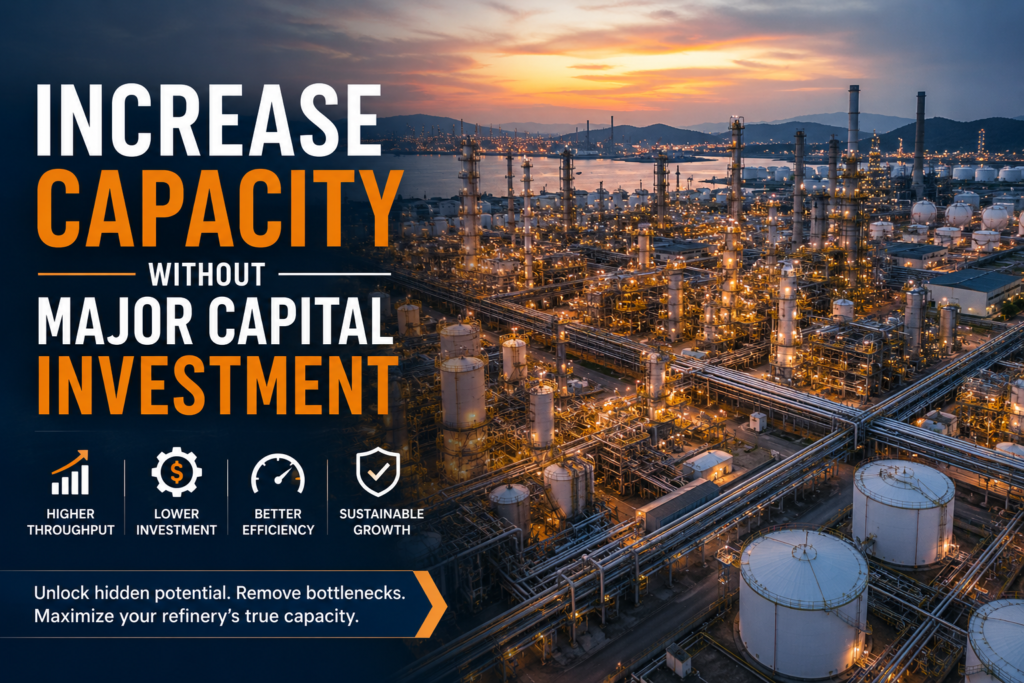
Introduction: Is Your Refinery Operating Below Its True Capacity?
Refinery debottlenecking studies provide a systematic approach to identifying bottlenecks, evaluating improvement opportunities, and increasing production capacity using existing assets
A refinery is designed to process a specific throughput, yet many facilities operate below their theoretical capacity for years without realizing why.
When production targets are not met, the immediate response is often to consider major capital investments—new equipment, additional processing units, or large-scale expansion projects. While these solutions may eventually be necessary, they are not always the most economical option.
Refinery debottlenecking studies provide a systematic approach to identifying bottlenecks, evaluating improvement opportunities, and increasing production capacity using existing assets.
In many cases, a single process constraint can limit the performance of an entire refinery.
This hidden limitation, commonly referred to as a bottleneck, may exist within a distillation column, heat exchanger network, compressor system, utility infrastructure, or another critical process area.
A structured debottlenecking study helps identify these constraints and evaluate practical solutions that can increase refinery throughput without major capital expenditure.
For refinery operators and project teams seeking higher production, improved profitability, and better asset utilization, debottlenecking often provides one of the highest-return opportunities available.
What Are Refinery debottlenecking studies?
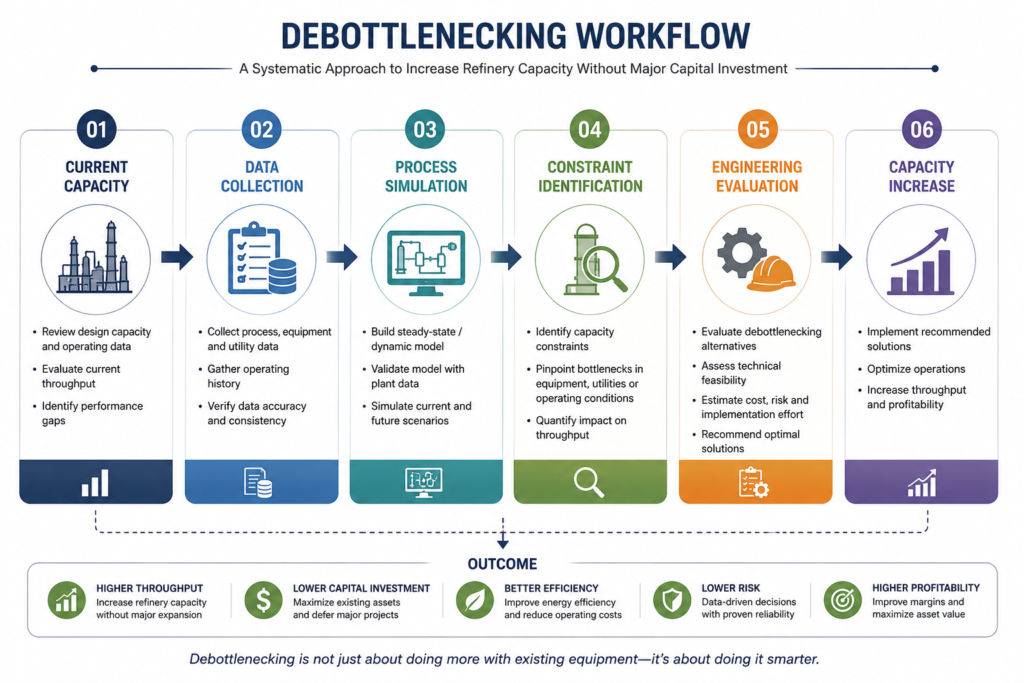
A debottlenecking study is a systematic engineering assessment designed to identify and remove process constraints that limit plant performance.
The objective is straightforward:
Increase throughput and operational efficiency using existing assets wherever possible.
Rather than assuming new equipment is required, engineers evaluate current operations to determine whether process improvements, operational changes, or targeted modifications can unlock additional capacity.
Typical Objectives of a Debottlenecking Study
- Increase refinery throughput
- Improve equipment utilization
- Reduce operational constraints
- Support capacity expansion plans
- Improve energy efficiency
- Maximize return on existing infrastructure.
Why Refinery Capacity Is Often Limited
Refineries are highly integrated facilities where every process unit depends on upstream and downstream systems.
A single equipment limitation can restrict the performance of an entire production chain.
Consider a six-lane highway that narrows to one lane. No matter how wide the remaining highway is, traffic flow is determined by the narrowest section.
Refineries operate in a similar way.
Common Refinery Bottlenecks
| Process Area | Typical Constraint |
|---|---|
| Distillation Units | Hydraulic limitations |
| Heat Exchanger Networks | Fouling and heat transfer restrictions |
| Compressors | Capacity limitations |
| Furnaces | Heat duty limitations |
| Hydrogen Systems | Insufficient hydrogen availability |
| Utilities | Steam, cooling water, or power constraints |
Identifying which constraint is limiting production is the first step toward increasing capacity.
Real-World Scenario: Increasing Throughput Without a Major Expansion
A refinery planned to increase crude processing capacity by approximately 10%.
Initial discussions focused on adding new equipment and investing in a costly expansion project.
Before proceeding, a debottlenecking study was conducted. The findings challenged the assumption that new equipment was required.
Engineering analysis revealed that:
- The crude distillation unit had additional capacity available.
- A compressor was operating near its design limit.
- Heat exchanger fouling was reducing energy efficiency.
- Utility systems required minor optimization.
Instead of constructing new processing units, the refinery implemented targeted improvements and operational adjustments.
Outcome
| Parameter | Before | After |
| Refinery Throughput | Base Capacity | Increased Capacity |
| Capital Investment | High Expansion Cost | Significantly Lower |
| Project Timeline | Long | Shorter |
| Return on Investment | Moderate | Improved |
The refinery achieved its production objectives while avoiding substantial capital expenditure.
Key Areas Evaluated During a Debottlenecking Study
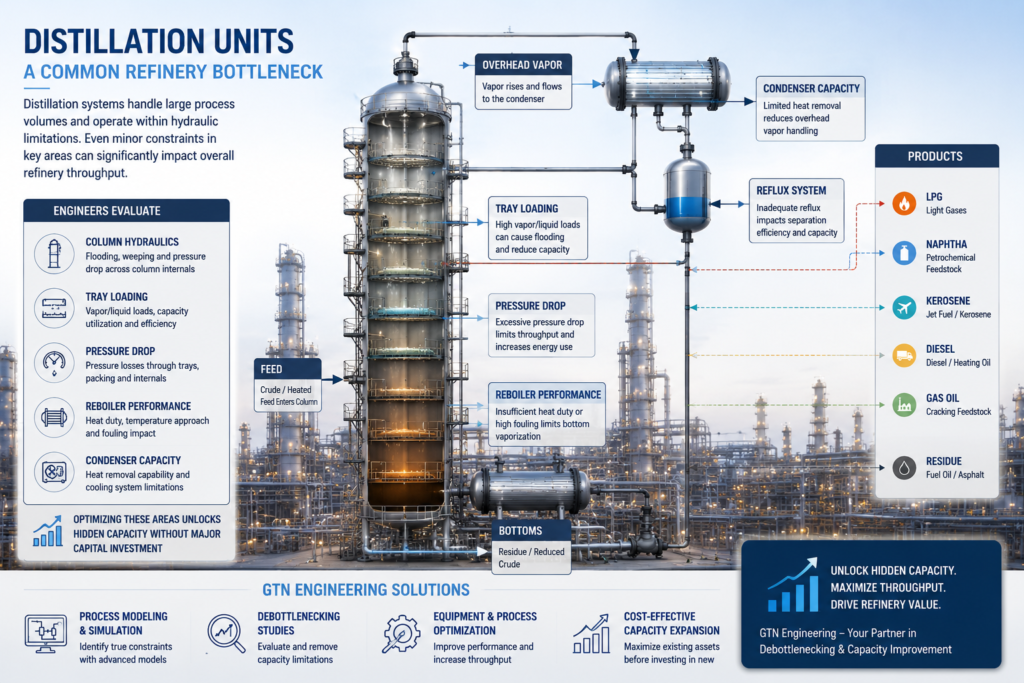
Distillation Units
Distillation systems frequently become refinery bottlenecks because they handle large process volumes and operate within hydraulic limitations.
Engineers evaluate:
- Column hydraulics
- Tray loading
- Pressure drop
- Reboiler performance
- Condenser capacity
Even minor constraints can significantly affect overall refinery throughput.

Heat Exchanger Networks
Heat exchangers are critical for energy recovery and process efficiency.
Over time, fouling reduces heat transfer performance, increasing fuel consumption and limiting throughput.
Engineers assess:
- Heat transfer performance
- Fouling impact
- Energy recovery opportunities
- Heat exchanger network optimization

Compressors and Rotating Equipment
Compressors often become limiting factors when throughput increases are attempted.
Areas typically evaluated include:
- Capacity limits
- Operating efficiency
- Pressure requirements
- Future operating scenarios
Even small improvements can unlock significant production gains.

Utility Systems
Utility systems are frequently overlooked during expansion planning.
Common constraints include:
- Steam generation capacity
- Cooling water systems
- Electrical distribution
- Instrument air networks
A refinery may have sufficient process equipment capacity but still be unable to increase production because utility systems have reached their limits.
The Role of Process Simulation in Debottlenecking Studies

Modern debottlenecking projects rely heavily on process simulation.
Process simulation is a critical component of Refinery debottlenecking studies, helping engineers evaluate constraints before implementing modifications.
Simulation models allow engineers to create a digital representation of refinery operations and evaluate multiple operating scenarios before modifications are implemented.
Benefits of Process Simulation
- Identifies hidden constraints
- Predicts equipment performance
- Evaluates future operating conditions
- Reduces project risk
- Supports investment decisions
Process simulation enables engineering teams to move beyond assumptions and make decisions based on data-driven analysis.
Benefits of Refinery debottlenecking studies
A successful debottlenecking project can generate benefits across multiple areas of refinery operations. Many of these benefits can be further enhanced through energy optimization initiatives.
In many refinery projects, debottlenecking studies identify opportunities to increase throughput and improve asset utilization before major capital projects are considered. This allows operators to evaluate lower-cost improvement options before committing to large-scale expansion investments
Operational Benefits
- Increased throughput
- Better equipment utilization
- Improved process stability
- Reduced operational constraints
Financial Benefits
- Lower capital expenditure
- Improved return on assets
- Reduced energy consumption
- Higher profitability
Strategic Benefits
- Faster implementation compared to major expansion projects
- Improved competitiveness
- Better long-term capacity planning
When Should a refinery Consider a Refinery debottlenecking Studies?
A refinery should consider a debottlenecking study when:
- Production targets are consistently missed
- Capacity expansion is being planned
- Equipment operates near design limits
- Energy consumption is increasing
- Feedstock changes are being evaluated
- New investment decisions are being considered
The earlier constraints are identified, the more opportunities exist to improve performance at lower cost.
Debottlenecking vs New Unit Construction
Before committing to a major expansion project, refinery operators should evaluate whether hidden constraints are limiting current performance.
| Factor | Debottlenecking Study | New Unit Construction |
| Capital Requirement | Lower | High |
| Project Duration | Shorter | Longer |
| Operational Disruption | Limited | Significant |
| Risk Level | Lower | Higher |
| Payback Period | Faster | Longer |
In many situations, debottlenecking provides a more cost-effective path to increasing production.
Frequently Asked Questions
What is a refinery debottlenecking study?
A refinery debottlenecking study identifies process, equipment, or utility constraints that limit plant throughput and evaluates solutions to increase capacity.
Can refinery capacity be increased without new process units?
In many cases, yes. Process optimization, equipment modifications, and utility improvements can unlock additional capacity without major capital investment.
What are common refinery bottlenecks?
Common bottlenecks include distillation columns, heat exchangers, compressors, furnaces, hydrogen systems, and utility networks.
How does process simulation support debottlenecking?
Process simulation helps engineers evaluate operating scenarios, identify constraints, and assess improvement opportunities before implementation.
Conclusion
Many refineries possess untapped production potential that remains hidden behind process constraints, equipment limitations, or utility restrictions.
A structured debottlenecking study helps identify these bottlenecks, evaluate improvement opportunities, and increase throughput without immediately resorting to major capital projects.
By combining engineering expertise, process simulation, equipment evaluation, and operational analysis, refinery operators can make informed decisions that improve profitability, optimize asset utilization, and support long-term growth.
Before investing in new infrastructure, it is worth asking a simple question:
Is your refinery truly operating at its maximum capacity—or is a hidden bottleneck holding it back?
Looking to Increase Refinery Capacity?
GTN Engineering provides specialized consulting services including:
- Refinery Debottlenecking Studies
- Process Modeling and Simulation
- Capacity Expansion Evaluations
- Energy Optimization Studies
- Process Equipment Design
Our engineering team helps refinery, petrochemical, and chemical facilities identify hidden constraints and unlock additional capacity through practical, data-driven solutions.
Need to Evaluate Refinery Capacity Expansion Opportunities?
GTN Engineering provides refinery debottlenecking studies, process simulation, and capacity expansion evaluations to help facilities increase throughput while minimizing capital investment.
Contact GTN Engineering to discuss your refinery performance and expansion objectives.
About the Author
This article was prepared by the engineering team at GTN Engineering, specializing in refinery debottlenecking studies, process simulation, energy optimization, and capacity expansion projects for refinery, petrochemical, and chemical industries