Your Plant Isn’t Underperforming Because It’s Too Small
Process Optimization vs Debottlenecking is a critical consideration for refineries, petrochemical facilities, and chemical plants looking to improve performance and increase profitability. A refinery, petrochemical facility, or chemical plant may be operating below its true potential without anyone realizing it.
Production targets are missed. Energy consumption rises. Equipment appears to be running at maximum capacity. The immediate assumption is often that the plant needs a major expansion project.
But what if the real issue isn’t a lack of capacity?
What if a single exchanger, compressor, column, control strategy, or operating parameter is quietly restricting the performance of the entire facility?
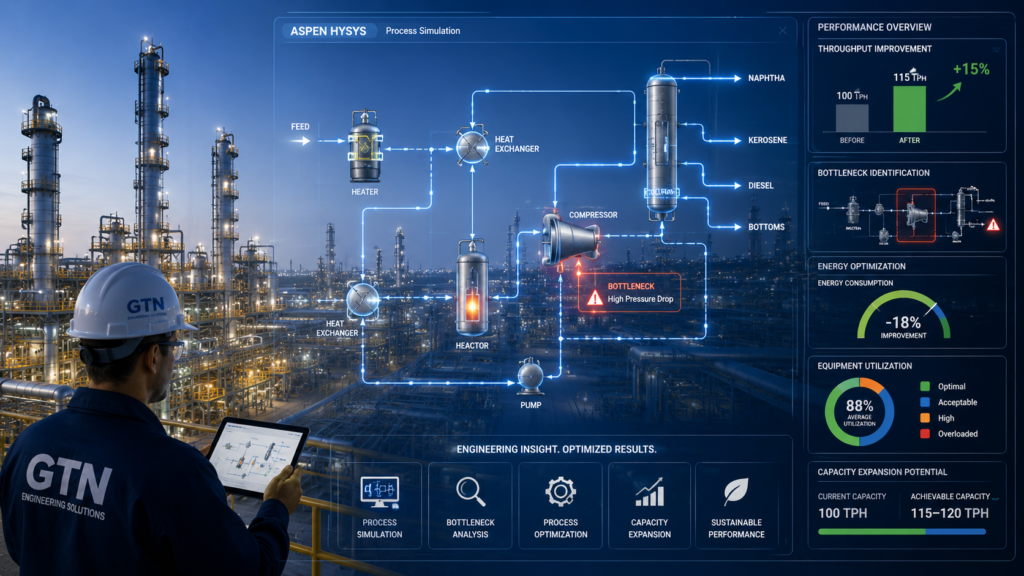
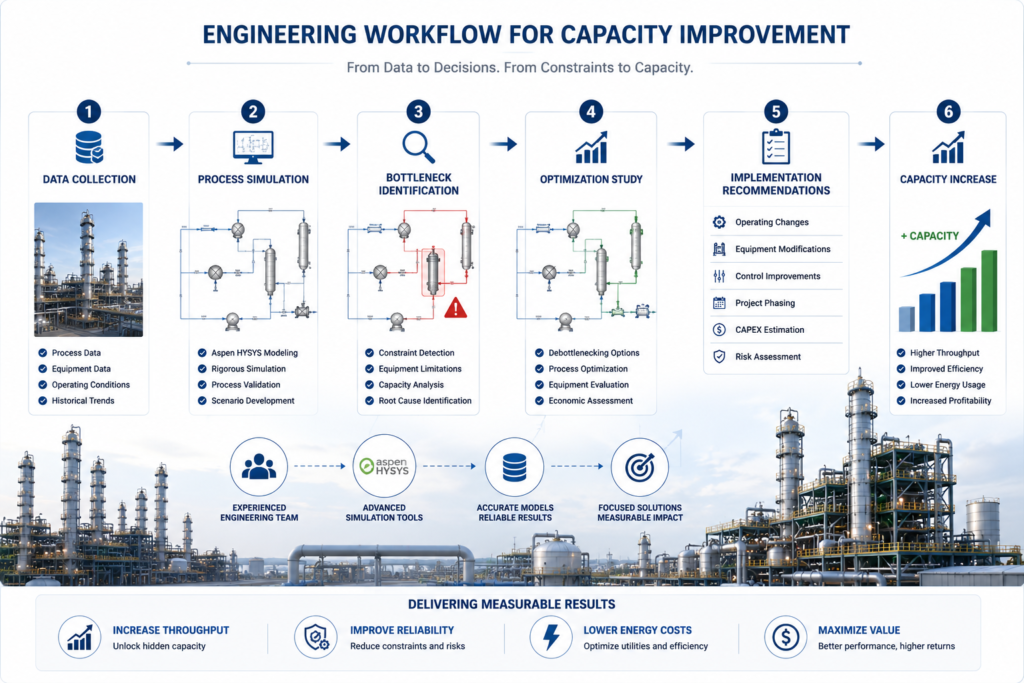
This is where two engineering approaches come into focus: Process Optimization and Debottlenecking. At GTN Engineering Solutions, engineers use process simulation and engineering analysis to help process plants improve efficiency, remove bottlenecks, and increase capacity.
Although these terms are often used interchangeably, they solve different problems and deliver different outcomes.
Understanding the difference can help plant owners make smarter investment decisions, improve profitability, and unlock hidden production capacity without unnecessary capital expenditure.
A Real-World Scenario
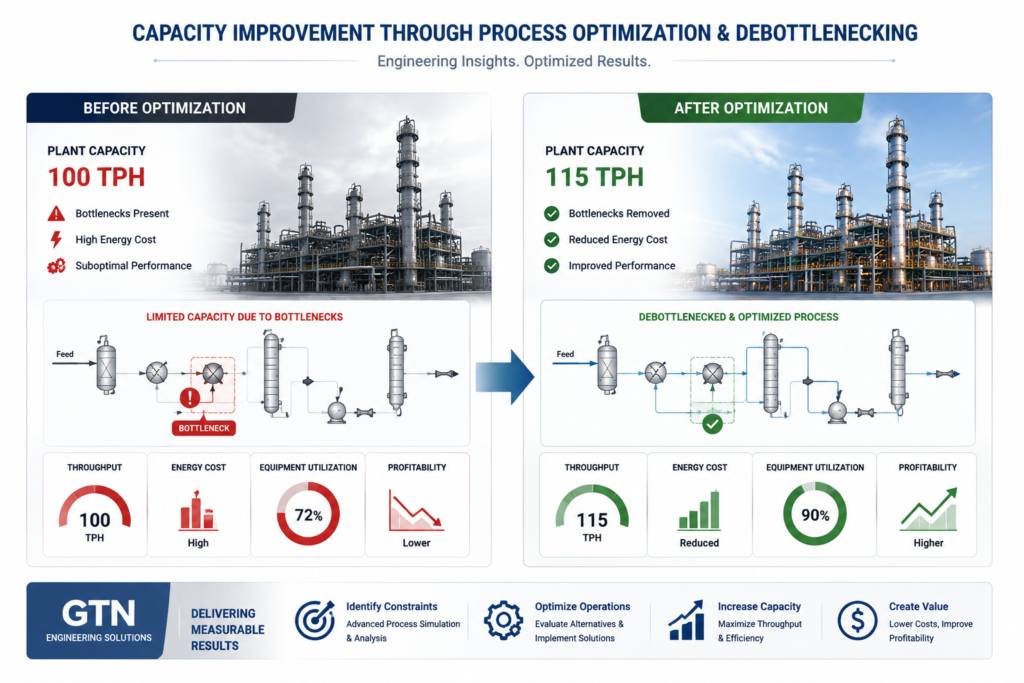
Imagine a refinery designed to process 100,000 barrels per day.
Over time, demand increases and management wants to push production to 115,000 barrels per day.
However:
- Furnace outlet temperatures become unstable
- Pressure drops increase across process units
- Compressor loading approaches maximum limits
- Product quality begins to fluctuate
Management faces a critical question:
Should the plant optimize its operation or invest in a debottlenecking study?
The answer depends on what is limiting performance.
What is Process Optimization?
Process optimization is the systematic improvement of plant operations to achieve better performance using existing assets. These studies are commonly performed using advanced Process Simulation Services to evaluate plant performance under different operating conditions.
The goal is to maximize efficiency while minimizing costs, energy consumption, and operational losses.
Instead of modifying equipment, optimization focuses on improving how the process operates.
Typical Process Optimization Activities
- Operating condition adjustments
- Control strategy improvements
- Energy integration studies
- Heat recovery improvements
- Process simulation analysis
- Utility consumption reduction
- Yield enhancement initiatives
Expected Benefits
| Benefit | Impact |
|---|---|
| Lower Energy Consumption | Reduced operating costs |
| Improved Product Yield | Higher profitability |
| Better Process Stability | Fewer operational issues |
| Reduced Utility Usage | Improved efficiency |
| Lower Emissions | Sustainability improvements |
What is Debottlenecking?
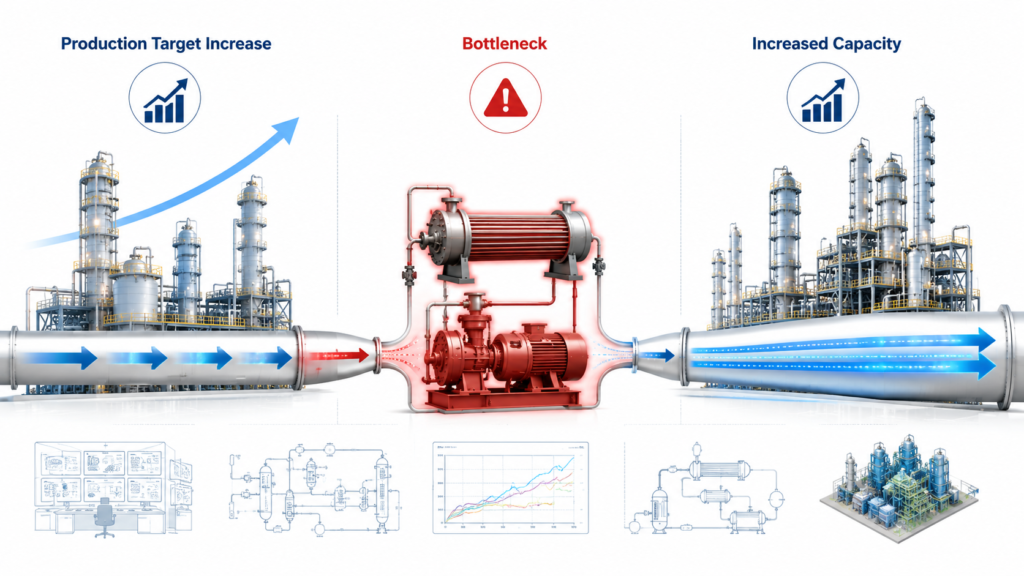
Debottlenecking is the process of identifying and eliminating specific constraints that limit plant capacity.Through detailed Debottlenecking Studies, engineers can identify capacity constraints and unlock hidden production potential.
Every process plant has a weakest link.
That limitation may be:
- A heat exchanger
- Distillation column
- Compressor
- Pump
- Reactor
- Furnace
- Control valve
- Utility system
When that bottleneck reaches its maximum capacity, the entire plant becomes constrained.
Debottlenecking removes or reduces these limitations.
Typical Debottlenecking Actions
- Equipment upgrades
- Heat exchanger modifications
- Additional pumps or compressors
- Column internals replacement
- Piping modifications
- Utility system improvements
- Control system enhancements
Expected Benefits
| Benefit | Impact |
| Increased Throughput | Higher production rates |
| Capacity Expansion | Delayed capital projects |
| Improved Asset Utilization | Better ROI |
| Reduced Production Constraints | Operational flexibility |
| Higher Revenue Potential | Increased profitability |
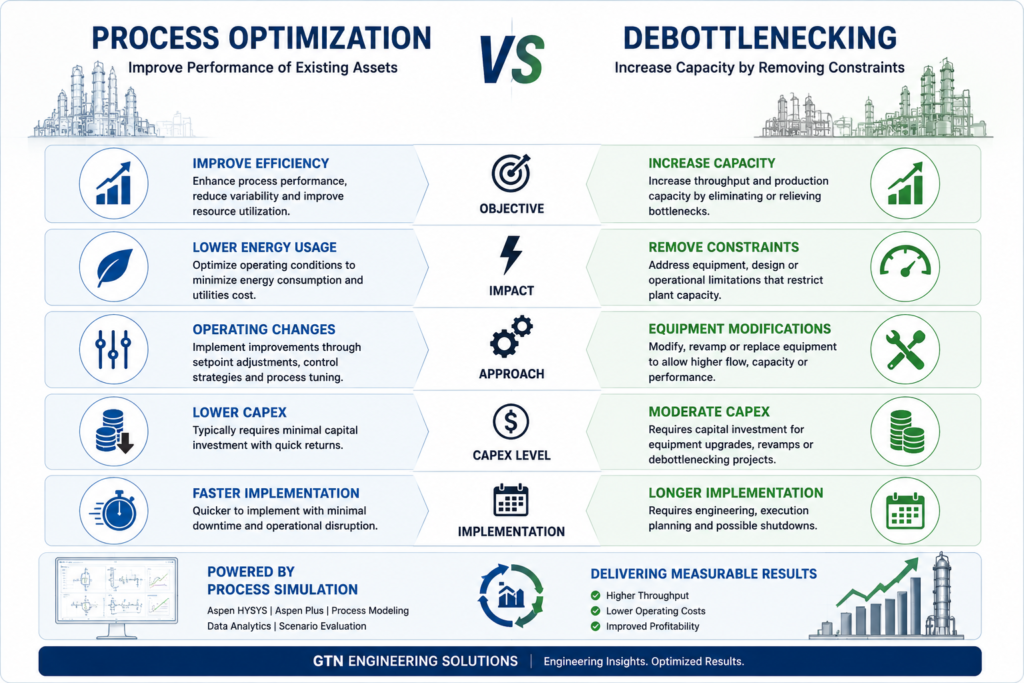
Process Optimization vs Debottlenecking: Key Differences
The Hidden Cost of Ignoring Bottlenecks
Many facilities continue operating with hidden constraints for years.
Consider a petrochemical plant producing 500,000 tons annually.
If a bottleneck is restricting production by just 5%, the facility may be losing:
25,000 tons of annual production capacity.
Depending on product value, this can translate into millions of dollars in unrealized revenue every year.
This is why leading operators regularly perform debottlenecking assessments before investing in new facilities.
Process Optimization vs Debottlenecking: When Optimization Delivers Better Results
Optimization is often the best choice when:
1. Energy Costs Are Increasing
Rising fuel and utility costs can significantly impact profitability.
Optimization studies can identify opportunities for:
- Heat recovery
- Utility reduction
- Improved operating conditions
2. Product Quality Variability Exists
Process simulation and optimization help stabilize operations and improve product consistency.
3. Existing Capacity Is Sufficient
If production targets are already being met, improving efficiency may deliver a higher return than increasing capacity.
Process Optimization vs Debottlenecking: When Debottlenecking Delivers Better Results
Debottlenecking becomes the preferred option when:
1. Production Demand Exceeds Capacity
The market requires more product than the plant can currently produce.
2. Critical Equipment Limits Throughput
One process unit consistently restricts production.
3. Expansion Projects Are Too Expensive
A debottlenecking project may achieve 10–20% capacity gains at a fraction of the cost of a major expansion.
Why Process Simulation Is Essential
Many bottlenecks are not obvious.
The apparent limitation may only be a symptom.
For example:
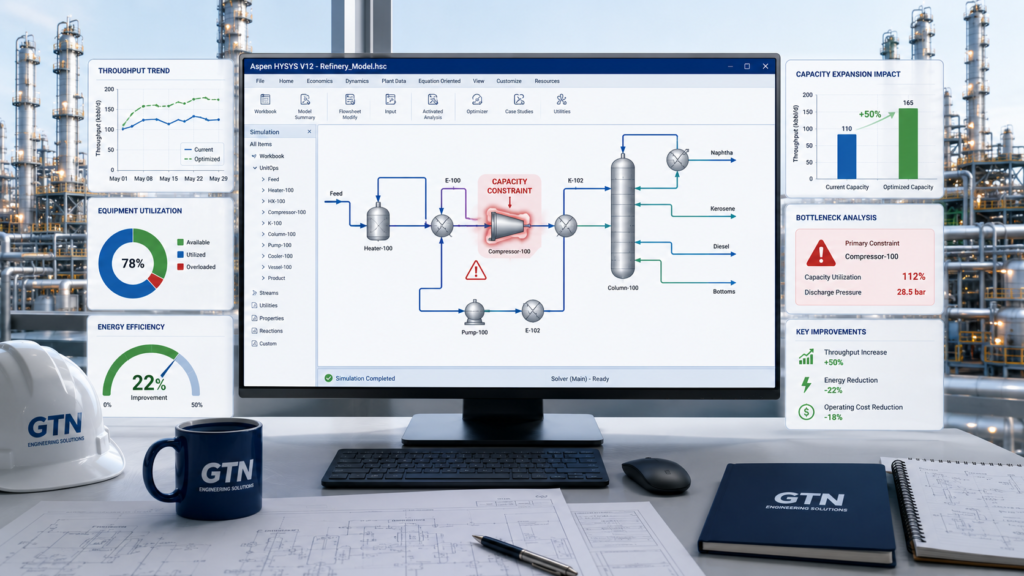
A compressor may appear overloaded.
However, simulation may reveal that an upstream exchanger is causing excessive pressure drop, creating the actual bottleneck.
Advanced process simulation allows engineers to:
- Identify true constraints
- Evaluate improvement options
- Predict plant performance
- Reduce project risk
- Optimize investment decisions
This is why modern debottlenecking studies increasingly rely on simulation tools such as Aspen HYSYS an
Why Process Simulation Is Essential
Many bottlenecks are not obvious.
The apparent limitation may only be a symptom.
For example:
A compressor may appear overloaded.
However, simulation may reveal that an upstream exchanger is causing excessive pressure drop, creating the actual bottleneck.
Advanced process simulation allows engineers to:
- Identify true constraints
- Evaluate improvement options
- Predict plant performance
- Reduce project risk
- Optimize investment decisions
This is why modern debottlenecking studies increasingly rely on simulation tools such as Aspen HYSYS and Aspen Plus.
Process Optimization vs Debottlenecking: Can They Work Together?
How GTN Engineering Solutions Helps
At GTN Engineering Solutions, we help refineries, petrochemical facilities, and process industries improve operational performance through:
- Process Optimization Studies
- Debottlenecking Studies
- Process Simulation Services
- Aspen HYSYS Modelling
- Capacity Expansion Analysis
- Feasibility Studies
- Process Design Engineering
Our engineering approach focuses on identifying practical opportunities to improve plant performance while minimizing capital expenditure and operational risk.
Conclusion
Process optimization and debottlenecking are not competing strategies.
They are complementary engineering approaches designed to improve plant performance from different perspectives.
If your goal is greater efficiency, lower energy consumption, and improved operational stability, process optimization may provide the best return.
If your objective is increased production capacity and revenue growth, debottlenecking often delivers the greatest value.
The key is understanding where the real constraint exists—and making decisions based on engineering analysis rather than assumptions.
Facilities that combine optimization, simulation, and targeted debottlenecking consistently achieve higher profitability, better asset utilization, and stronger long-term competitiveness.
Need Help Identifying Bottlenecks in Your Plant?
Whether your goal is to improve efficiency, increase throughput, reduce energy consumption, or evaluate capacity expansion opportunities, GTN Engineering Solutions can help through process simulation, debottlenecking studies, and engineering analysis.
Contact GTN Engineering Solutions today to discuss your project requirements.
Frequently Asked Questions
What is the difference between process optimization vs debottlenecking?
Process optimization improves efficiency using existing assets, while debottlenecking removes constraints that limit production capacity.
How much capacity increase can a debottlenecking study achieve?
Depending on plant conditions, debottlenecking projects can often increase throughput by 5% to 20% or more.
Is process simulation necessary for debottlenecking?
Yes. Simulation helps identify the true root cause of constraints and reduces implementation risk.
Which industries benefit from debottlenecking?
Refineries, petrochemical plants, chemical plants, gas processing facilities, and other process industries commonly benefit from debottlenecking studies.
Which approach has the fastest ROI?
Both can provide excellent returns, but process optimization generally requires lower investment and can deliver faster payback.