

Introduction
Pinch Analysis and Heat Integration are among the most effective methods used by refineries to reduce energy costs and improve process efficiency. Energy is one of the largest operating costs in refinery operations. Every day, valuable heat is lost through cooling systems, exhaust gases, and process streams.
However, this wasted energy can often be recovered and reused. By applying Pinch Analysis and Heat Integration, refineries can reduce fuel use, lower steam demand, and improve plant performance.
Many refinery operators look for ways to increase profits without major capital investment. In many cases, the solution is not new equipment. Instead, it is better use of existing energy.
In this article, we explain how Pinch Analysis and Heat Integration work and how they help refineries reduce energy costs through practical refinery examples.
This is where Pinch Analysis and Heat Integration play an important role.
These engineering techniques help refineries recover and reuse heat that is already available within the process. Instead of consuming additional fuel or utilities, plants can make better use of existing energy. This helps reduce operating costs, improve efficiency, and lower emissions.
Many refinery operators focus on adding new equipment when looking for improvements. However, some of the biggest savings can come from using energy more effectively.
In this article, we explain how Pinch Analysis and Heat Integration work and how they help refineries reduce energy costs through practical refinery examples.
Refineries often combine Pinch Analysis with process simulation studies to identify energy-saving opportunities. Learn more about our Process Simulation for Plant Expansion and Revamp Projects.
What Is Pinch Analysis and Heat Integration?
Pinch Analysis helps engineers find ways to save energy in a refinery.
Every refinery has hot streams that need cooling and cold streams that need heating. In many plants, these streams work separately. As a result, useful heat is often wasted.
Pinch Analysis helps engineers match these streams and recover more heat. This reduces fuel use, lowers utility costs, and improves efficiency.
The main objectives are to:
- Reduce fuel consumption
- Lower steam demand
- Reduce cooling requirements
- Improve energy efficiency
- Decrease operating costs
The study identifies the maximum amount of heat that can be recovered before investing in new equipment.
What Is Heat Integration?
While Pinch Analysis identifies opportunities, Heat Integration turns those opportunities into practical solutions.
Heat Integration involves transferring heat from hot process streams to cold process streams. Instead of rejecting valuable heat, the refinery reuses it where heating is required.
Examples include:
- Preheating crude oil using hot product streams
- Recovering heat from reactor outlet streams
- Reducing steam consumption through heat recovery
- Improving heat exchanger network performance
The result is lower utility

Why Refineries Need Pinch Analysis and Heat Integration
Refineries handle large amounts of thermal energy every day.
Units such as:
- Crude Distillation Units (CDU)
- Vacuum Distillation Units (VDU)
- Hydrotreaters
- Hydrocrackers
- Reformers
operate at high temperatures.
Without proper heat recovery, refineries waste large amounts of energy every day.
For example, heat is often lost through:
– Cooling water systems
– Air coolers
– Furnace exhaust gases
– Hot product streams
– Condensers
As a result, fuel consumption increases and operating costs rise.
Pinch Analysis helps identify where these losses occur and how they can be reduced.
Real Refinery Scenario 1: Improving a Crude Distillation Unit
A crude distillation unit is one of the largest energy consumers in a refinery.
Before entering the distillation column, crude oil must be heated to a high temperature. This heating is normally provided by a fired heater.
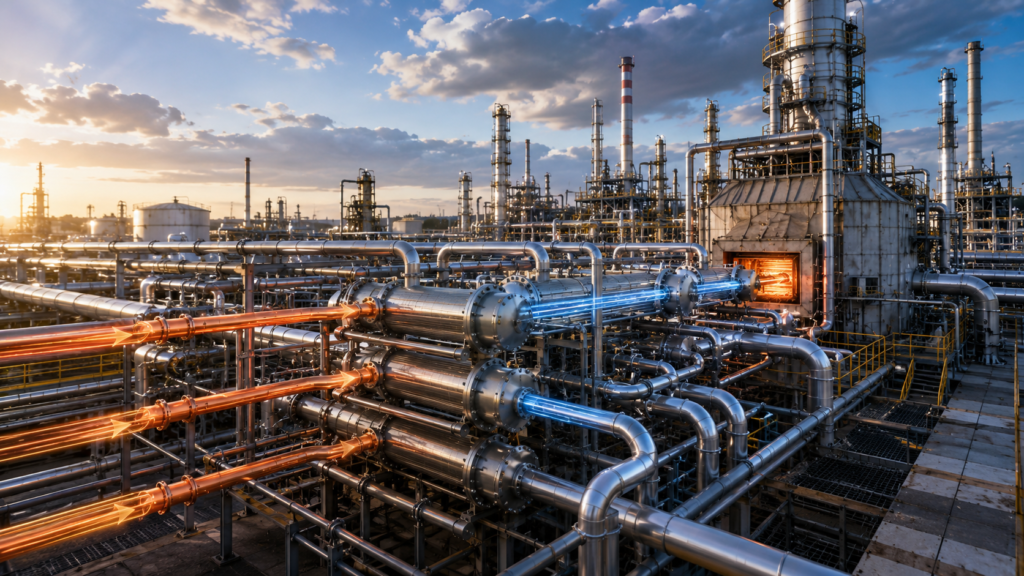
In many refineries, hot diesel and gas oil streams leave the process carrying significant amounts of recoverable heat. If this heat is not reused, the furnace must consume additional fuel.
A Pinch Analysis study can identify opportunities to transfer heat from these hot streams back to the crude preheat train.
As a result:
- Furnace fuel demand decreases
- Energy efficiency improves
- Operating costs are reduced
- Emissions are lowered
This is one of the most common applications of Heat Integration in refinery operations.
Many of these opportunities are also discovered during refinery debottlenecking studies.
Real Refinery Scenario 2: Recovering Heat in a Hydrotreater
Hydrotreaters operate at elevated temperatures and pressures to remove impurities from petroleum products.
After processing, the reactor effluent leaves the reactor at a high temperature.
In some facilities, this heat is removed using coolers before the stream moves to the next stage. This approach wastes valuable energy.
A Heat Integration study may reveal an opportunity to use the hot reactor effluent to preheat the incoming feed stream.
This simple modification can:
- Reduce steam consumption
- Improve thermal efficiency
- Lower utility costs
- Reduce operating expenses
Instead of wasting energy, the refinery recovers and reuses it within the process.
Real Refinery Scenario 3: Reducing Steam Consumption Across the Refinery
Steam is one of the most important utilities in a refinery.
It is used for:
- Process heating
- Reboilers
- Stripping operations
- Utility services
Over time, steam demand often increases due to process changes and equipment limitations.
A refinery-wide Pinch Analysis study can identify areas where process heat can replace steam usage.
For example, a hot product stream may be capable of providing heat that is currently supplied by steam.
By recovering available heat, the refinery can:
- Reduce steam generation requirements
- Lower fuel usage in boilers
- Improve utility efficiency
- Reduce operating costs
These savings often extend across multiple process units.
Benefits of Pinch Analysis and Heat Integration
Lower Energy Costs
Reducing utility consumption directly lowers operating expenses.
Fuel, steam, and cooling costs can be significantly reduced through effective heat recovery.
Improved Process Efficiency
Better heat recovery means more efficient use of available energy throughout the refinery.
Reduced Carbon Emissions
Lower fuel consumption results in lower greenhouse gas emissions.
This supports sustainability goals and environmental compliance.
Better Use of Existing Equipment
Improved heat recovery reduces the load on furnaces, boilers, and cooling systems.
This can help extend equipment life and improve reliability.
Increased Profitability
Lower operating costs improve refinery margins and overall profitability.
Energy optimization projects often begin with a detailed feasibility assessment.
Common Challenges During Implementation
Although the benefits are significant, successful implementation requires careful analysis.
Common challenges include:
- Incomplete operating data
- Fouled heat exchangers
- Space limitations
- Aging equipment
- Process constraints
These factors must be evaluated before implementing heat recovery projects.
How GTN Engineering Solutions Can Help
At GTN Engineering Solutions, we help refineries identify practical opportunities to improve energy efficiency and reduce operating costs.
Our expertise includes:
- Pinch Analysis Studies
- Heat Integration Studies
- Process Simulation
- Energy Optimization
- Heat Exchanger Network Design
- Debottlenecking Studies
Our engineering team combines process knowledge with advanced simulation tools to deliver practical and cost-effective solutions for refinery operations.
Conclusion
Rising energy costs continue to challenge refinery operators around the world. However, significant savings are often available within existing operations.
Pinch Analysis and Heat Integration help refineries recover wasted heat, reduce utility consumption, and improve process efficiency without major capital investment.
Whether the opportunity lies in a crude distillation unit, hydrotreater, or utility system, effective heat recovery can deliver long-term operational and financial benefits.
For refineries seeking higher efficiency and lower operating costs, Pinch Analysis remains one of the most effective energy optimization tools available today.